
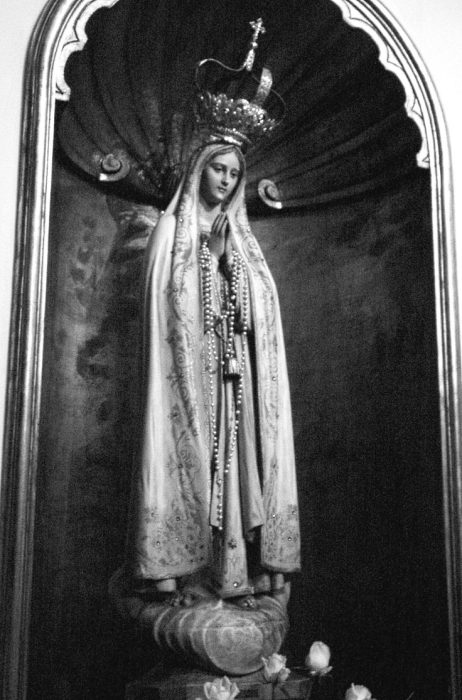
Why are there so many versions of the Fatima prayer in Latin?
Simply put, the humble and uneducated shepherd children of Fatima relayed the Rosary prayer from Our Lady in Portuguese, their native language. Based on a private revelation, this prayer sadly has not been provided with an official Latin version from the Church. As a result, dozens of versions exist, and Latinists or in some cases people with little Latin knowledge have created much variation on almost every word in the prayer.
What then is a Latin praying Catholic to do?
One of the most prevailing and all encompassing benefits of Latin is its universality. A faithful Catholic can go anywhere in the world and pray together with other members of the Church in the same exact language and pray the same exact prayers together. He or she could likewise attend a Traditional Latin Mass and be able to pray in the same exact words and in the same exact language that countless Saints have throughout the centuries. Nevertheless, this Catholic then joins in a public devotion of the Holy Rosary in Latin, praying the most common prayers in the Church’s sacred language, and reaches the Fatima prayer and at that one and only point he encounters variation and a lack of unity. A universal standard is unquestionably needed, but because we have no official Church authority presently willing to undertake such a venture and then disseminate it to the faithful, we ought to find and then adopt the next best solution.
No need to take a class or brush up on your high school Latin to add another translation to the list–let’s start by first seeing what’s out there. Since most information is disseminated online these days, in order to find the most prevalently used version, a curious individual could do a search for “Fatima Prayer in Latin” and see the different versions that may be found. It just so happens that such an investigation was thoroughly performed in 2009 and has again been performed and confirmed in 2019. The many sites and content of this inquiry are available here.
The results make clear that one version in particular stands out as being used in more places than any other version by a ratio of roughly fifteen to one. This version also is supported by the most amount of traditional Catholics in the world with only one word in minor variation form place to place. It is used and published by EWTN, catholic.org, thesacredheart.com, patheos, latinoffice, among many others. Also significantly, this version is used by a priestly group that has by far the largest numbers of traditional Catholic followers and priests and is used in their seminary. Finally, the international federation of Catholic lay organizations dedicated to the spreading and defense of the Traditional Latin Mass since 1964 and which helped influence the implementation of Pope Benedict’s motu proprio, Summorum Pontificum, Una Voce, also has published a version nearly identical to this one. Thus, in terms of universality of translation by sheer number, we can clearly declare a winner.
Which version has by far the most universal usage?
Dómine Jesu, dimitte nobis débita nostra, salva nos ab igne inferni, perduc in caelum omnes ánimas, praesertim eas, quae misericórdiae tuae máxime indigent.
How does this translation compare word by word?
Here is a breakdown of the various parts of the prayer with translation comments and the variations that appear in minority translations:
- Domine Jesu – translated literally “Lord Jesus,” which in this case does have a clear distinction from the “Oh my Jesus.” Defenders of this majority translation cite that this opening has been used for quite some time for this prayer due to its being of a more liturgical and grammatically proper nature. While “O mi Jesu” is a literal translation, liturgical prayers do not follow this structure. Moreover, the vocative case typically would express such a sentiment without adding the “O.” Thus, the “O mi Jesu” sounds much more like a translation rather than a prayer composed in the standard Roman liturgical style. Since the liturgy is to inform and direct our prayers, the ideal then follows the model provided in other prayers handed down by the Church.
- dimitte nobis debita nostra – “forgive us our sins” or literally “our debts.” This phrase comes verbatim from the Pater Noster. Out of the various minority translations, there are a couple that translate “forgive” as “remitte” (to send back, remit, dimmish) or “indulge” (to grant, be kind, or be lenient to), and while both words can in some contexts have that meaning, they have more of a different sense about them that does not quite fit as well as sticking with the liturgical and familiar words of the Pater. A couple other translations also use “peccata” instead of the word “debita” that is used in the Pater.
- salva nos ab igne inferni – “save us from the fires of hell.” The word “salva” literally means “to save” and is used frequently in both liturgical and private prayers (i.e. “Corpus Christi salva me,” litanies’ responses “salva nos,” or in compline “salva nos domine…”). The minority variations here simply fail in meaning and / or usage and seemingly without real purpose; “libera” (free, liberate), “custodi” (guard, protect), “conserva” (keep safe, save from danger, preserve): rare usage in any Latin prayers. Only one minority translation translates “fires” as “ignibus,” which is most likely a translation from the English, since the Portuguese is singular “fire of hell,” which corresponds to the singular “igne” in Latin. The other word that is used in variation is “inferiori” (below, beneath, underneath) instead of “inferni” (underground, infernal, of hell). This is the most commonly found variation among the translations and many of the minority translators will be identical to the rest except for this one word. It would seem that “inferni,” by its definition has a far clearer sense of hell and its burning fires that are asked to be saved from. The translation “ab igne inferiori” would be more in line with saying “from the fires (of) below” whereas “ab igne inferni” is saying “from the fires of hell.” Finally, the original Portuguese word used is “inferno,” which directly corresponds to the Latin use of “inferni.” One small minority translation also uses “gehennae,” referring to Gehenna, the place that Christ used as a metaphor for hell; however, the literal use of the place fits much better in this instance with the original prayer and its clear intent to reference “the fire of (the actual place) hell.”
- perduc in caelum omnes animas – “lead all souls to heaven.” “Perduc” means “to lead, guide, or bring through.” This word represents the literal translation of the Fatima prayer in both the English and original Portuguese, which uses the word “levai,” which means “to lead.” Also “perduc” is used commonly in other prayers such as in the confiteor “miseratur tui…perduc ad vos…” Minority translations here will use either “conduc” (to draw), “duc” (to lead, command), and one use has even been found of “attrahe” (to attract, draw). “Duc” has a strong sense of commanding the action, which fails to as closely match in translation of the idea of the prayer. “Conduc” and “attrahe” seem to both be used for theological reasons in order to try to counter the heretical teaching of universalism, since some modernist adherents to this idea will cite the Fatima prayer as a sort of “proof” that God actually leads and brings all souls to heaven. Such a universalist notion, however, is entirely foreign and even directly contrary to the visions at Fatima. Interestingly, according to Br. Alexis Bugnolo, who bases his opinion on a discovery of the original Portuguese prayers written by Sister Lucia, the original Fatima prayer, he and others claim, was not referring to “all souls” but rather “all the poor souls” in Purgatory that God is leading through stages of purification into heaven. Nevertheless, the portion referring to God leading “all souls to heaven” understood correctly is a request for God to pour out His grace on all souls, which prepares, directs, and elicits every good work. “Lead us not into temptation” is a prayer requesting God to not permit us to be tempted or tested severely but rather that He would “deliver us from the evil (one).” God does not actually lead into temptation in the sense actively willing evil be done to one to be tempted to his limits, and God similarly does not actually lead and bring every single soul into heaven contrary to its will. A sobering matter of divine revelation will always remain that souls are in fact damned for all eternity, and this prayer in no way detracts from that reality, as the children at Fatima themselves were first shown a terrifying vision of hell where souls were actively falling into “like snowflakes.”
At least one minority translation omits “animas” (souls) altogether, so it says to simply “lead all…” and another takes liberty to add “ad caeli gloriam” (to the glory of heaven) even though these words are not found in the Portuguese, Italian, French, Spanish, German, or English translations, and this means of referring to heaven cannot be found in any other Latin prayers or translations.
- praesertim eas – “especially those.” Some other variations exist in minority translations as “præcípue” (especially, chiefly) or “praesertim illas” (especially those). “Illas,” however, remains less than ideal as it would be pointing to a more distinct and demonstrative “those” than the ones referenced here in this prayer; whereas, “eas” clearly points to the same “they” in reference to the souls that were mentioned previously.
- quae misericórdiae tuae máxime indigent – “(who are) in most need of Thy mercy.” At least one minority translation inverts the last words as “maxime indigent misericordia tuae.” In Latin there is no official or standard word order because of declensions, and this feature provides a particular freedom to emphasize certain words or make the translation flow more poetically. Typically for emphasis and strength the last word in a Latin sentence will often be the verb. Last words often are also the most memorable and pack the most punch. For example, the St Michael prayer ends with “divine virtutae in infernum detrude” – literally in order “by divine power into hell cast” rather than the English leaving with “seeking the ruin of souls.” In this case of the Fatima Prayer, the majority translation ends with the verb “indigent” (to need, require).
A few other minority translations use varying orders of the words “maxime egentes misericordiae tuae” (most needy / poor of thy mercy) or simply “misericordia” (mercy) followed by “egentes” (needy, poor) or even “ingentes” (huge, enormous). The variance among translations in word order especially at the end is not surprising. When translating into Latin the flow and sound as well as the emphasis and common usage should all be taken into account. In this case, the endings on “misericordiae” “tuae” “maxime” all share the same sound providing it with an exceptional ease and flow in prayer.
The entire prayer together in the majority translation possesses a remarkable rhythm and flow that also in a unique way sets it apart from all the others. Thus, due to its common usage, liturgical style, word choice, and particular flow, this version should ideally be used as a Fatima prayer translation of choice, until or unless at some time the bishops or pope would provide a standard Latin translation to be used by the faithful. But perhaps first let us pray for a continual and regular consecration of Russia and the world to Our Lady of Fatima!
What to do now with these insights?
Follow our Lady of Fatima’s urgent request …
Pray the Holy Rosary in Latin.